Findings Provided by a Machine Learning Clustering Model of Stellar Kinematics in Star Clusters Can be Used to Identify Runaway Stars
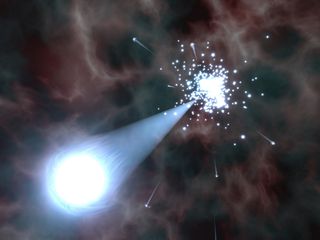
The need for developing a machine learning model that can detect these runaway stars is established in this research as it attempts to expand the domain of astrophysics to help astrophysicists understand tidal tail formation and the theoretical dark matter subhalos’ effects on celestial bodies.
Star clusters dissipate as internal and external gravitational interactions weaken its tidal radius, causing smaller groups of stars to split apart in several directions while pushing other stars along with it. The need for developing a machine learning model that can detect these runaway stars is established in this research as it attempts to expand the domain of astrophysics to help astrophysicists understand tidal tail formation and the theoretical dark matter subhalos’ effects on celestial bodies. Data from the ESA’s Gaia DR 3 was utilized and noise was removed through data cleaning with 4 parameters: RAdeg, DEdeg, PM, and Distance that were then factored into a K-means clustering algorithm, which created the star clusters. These 4 factors were subsequently compared and analyzed in various scatterplots. The findings revealed the model’s success in identifying potential candidates of runaway stars by confirming the existence of high proper-motion stars amongst other more similar proper-motion stars and the ability for stars to be separate by vast distances across their cluster, indicating possible tidal tails. Future improvements to work around various limitations encountered throughout this research focus on the development of a hybrid clustering-nueral network model to automatically detect and predict the likelihood of runaway stars from their clusters.
Explore More!
Related Projects

© 2022 Inspirit AI. All Rights Reserved.