
Back To Projects
Brightness helps CNN classify a subset of the images from Google Quick Draw

Serena F.

We made a CNN that learned to recognize and classify sketches from Google’s Quick Draw dataset and implemented a novel brightness feature to test if it increased the accuracy.
We made a CNN that learned to recognize and classify sketches from Google’s Quick Draw dataset and implemented a novel brightness feature to test if it increased the accuracy. The results displayed up to a 4% increase in validation accuracy. To conduct experiments, we created 3 models, 1 with brightness and two without. In addition, we used different numbers of epochs, metalayers, kernels, and sizes of kernels and dropouts.
Serena F.

Clayton Greenberg
Teaching Professor from UPenn
Related Projects
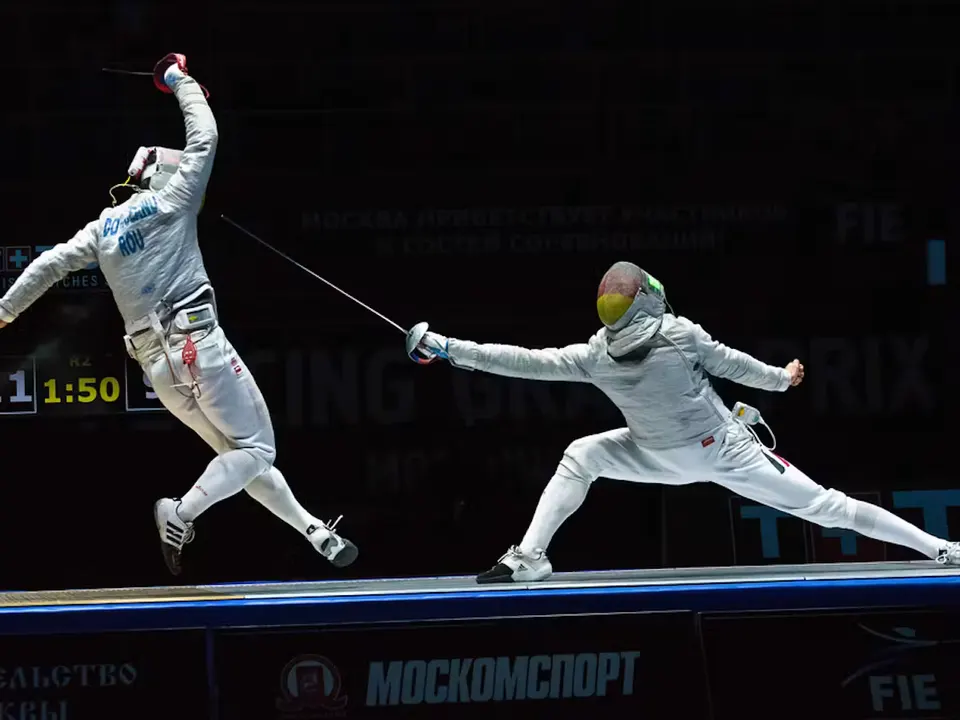
Allez Go: AI Fencing Referee
Technology in fencing is generally an underdeveloped field and automated referees present potentially significant benefits to the sport. Automated referees will offer a more consistent call compared to a group of human referees with slightly different interpretations of the fencing rules.

Jason M.
Mentored by Anna Orosz

Self-supervised DINOv2 versus Supervised CNNs for Insurance Claim Cost Predictions
This study investigates whether vehicle insurance claim amounts can be predicted directly from images of damaged cars by comparing CNN models, the self-supervised DINOv2 model, and GPT-5.5 as a vision language model. Results showed that DINOv2 performed best, achieving an R² of 0.12 compared with 0.07 for ResNet152V2 and 0.08 for ResNeXt50, while GPT-5.5 tended to overestimate repair costs, particularly for severe damage.
Rohan V.

Mentored by Ivan Felipe Rodriguez

A Methodology for Learning Airplane Descent Patterns
In this study, we trained a plane to land without human assistance.
Michael T.
Mentored by Sean Konz

© 2022 Inspirit AI. All Rights Reserved.