The Use of Artificial Intelligence in Gravitational Microlensing Detection for Dark Matter Discoveries
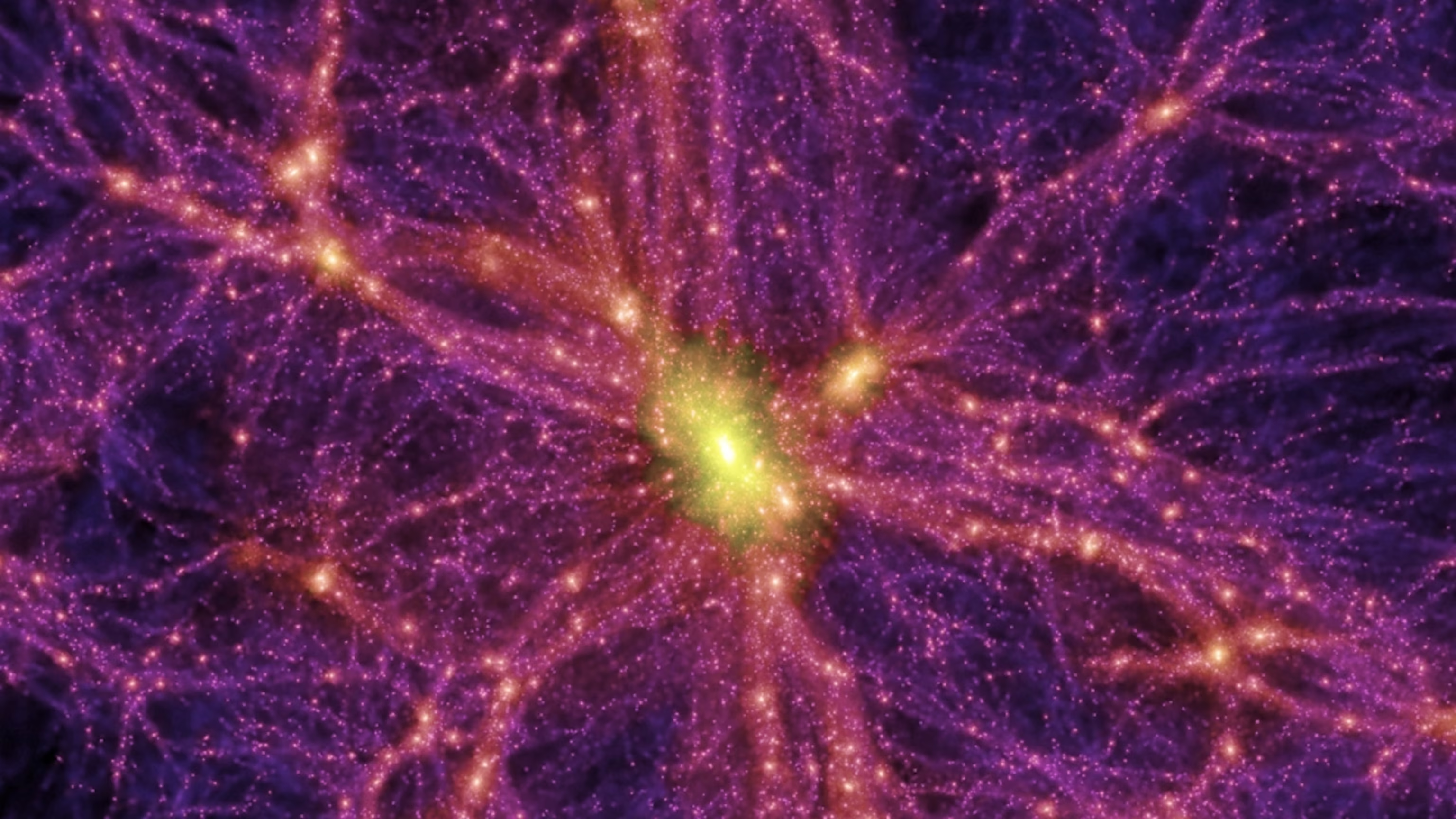
This research utilizes Artificial Intelligence to enhance the speed and accuracy of microlensing detection using data from 600,000 stars observed by The Zwicky Transient Facility. Through comparative analysis and hyperparameter tuning, the KNN model was identified as the most accurate, achieving 97% accuracy in detecting microlensing events, which may include dark matter, within the Milky Way.
Gravitational lensing has been used for over three decades as effectively the only tool to reveal the nature of "dark" sources in the Milky Way. "Dark" sources include stars, planets, black holes, or even dark matter. We hypothesized that by using 600,000 stars as data obtained from The Zwicky Transient Facility, a telescope at the California Institute of Technology, we could use Artificial Intelligence to increase the speed and accuracy of microlensing detection. The main objective of this project was to distinguish between microlensing and non-microlensing events, the former of which could be dark matter events. Through the rigorous testing of various Artificial Intelligence models, including Linear Regression, KNN, SVC, Decision Tree, and others, we conducted a comparative analysis to discern disparities in accuracy, precision, and other recall among these models Through hyperparameter tuning and the elimination of false positives, the KNN model was confirmed to be the most accurate model, generating a 97% accuracy for the detection of microlensing events within the Milky Way. This scientific inquiry aims to improve future searches for microlensing events, ultimately expediting the current scientific processes employed in microlensing detection and helping astronomers place search constraints on the nature of dark matter through AI.
Explore More!

Related Projects

© 2022 Inspirit AI. All Rights Reserved.