
SoilingNet: Convolutional Neural Networks for Analysis of Soiling Defects in Photovoltaic Panels
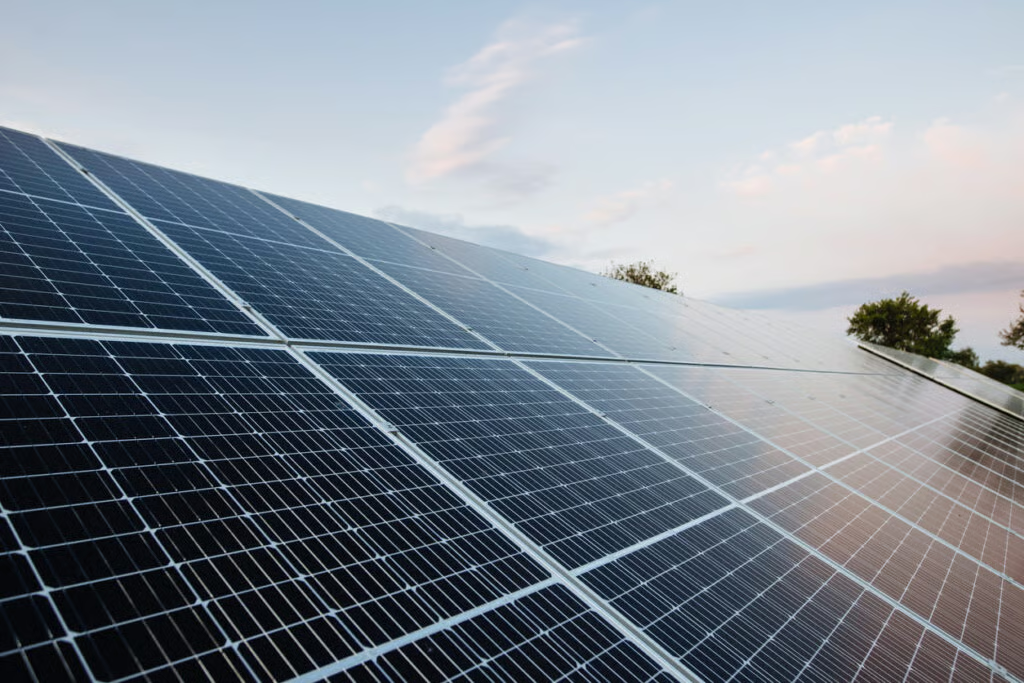
In our study, we present a two-step, fully supervised deep learning approach for analyzing solar panel soiling on a per-panel level.
Solar panel soiling is an important problem for the energy sector as we transition away from fossil fuels. Previous methods have aimed to analyze and combat soiling through the use of classical computer vision techniques or weakly supervised deep learning. In our study, we present a two-step, fully supervised deep learning approach for analyzing solar panel soiling on a per-panel level. From a single RGB image of a solar panel, combined with the environmental factor of solar irradiance, our method produces predictions for soiling type, soiling location, and soiling severity. We also introduce a first-of-its-kind dataset labeled with ground truth semantic segmentation maps for the purpose of solar panel soiling analysis. This dataset contains 1104 samples. We find that our model can achieve Jaccard indices in excess of 70 when predicting semantic segmentation maps and top-1 accuracy’s in excess of 92% when predicting soiling severity. Our method outperforms previous techniques in the domain of solar panel soiling analysis.
Explore More!

Related Projects

© 2022 Inspirit AI. All Rights Reserved.