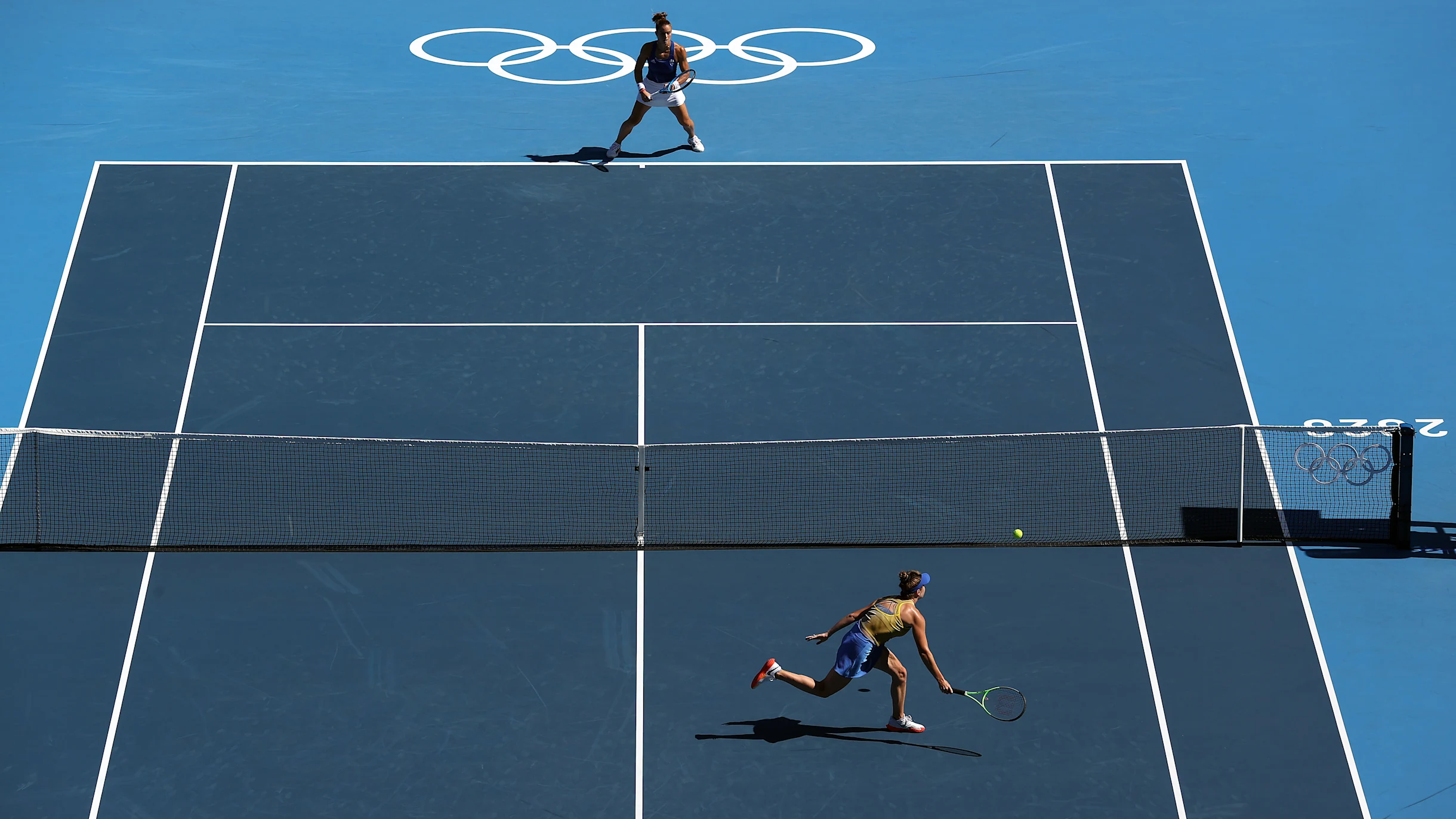
One of the best ways for tennis players to improve their game is to record and watch their own match footage, find patterns in the points they win and lose, and practice based on these realizations. However, watching match footage and documenting each point shot by shot is a very time-consuming process. This paper investigates an AI approach to transcribing tennis match footage, combining a deep convolution neural network (YOLOv4), a pose estimation model (Movenet), and a long short- term memory (LSTM) deep neural network. Looking at a transcript of each point will be far more efficient than watching entire match footage for a player to understand how they are losing and winning and analyze patterns in their game. The LSTM model in this project achieved accura- cies of 73.33% and 79.31% when classifying shot type (forehand, forehand volley, forehand slice, backhand, backhand volley, backhand slice, over- head/smash, and serve) for players on the close side and opposite side of the net, respectively, and 55.17% and 60.00% when classifying the di- rection of a shot (cross-court, down the line, down the middle, inside in, inside out, out wide, down the t, and body) for players on the close side and opposite side of the net, respectively.
One of the best ways for tennis players to improve their game is to record and watch their own match footage, find patterns in the points they win and lose, and practice based on these realizations. However, watching match footage and documenting each point shot by shot is a very time-consuming process. This paper investigates an AI approach to transcribing tennis match footage, combining a deep convolution neural network (YOLOv4), a pose estimation model (Movenet), and a long short- term memory (LSTM) deep neural network. Looking at a transcript of each point will be far more efficient than watching entire match footage for a player to understand how they are losing and winning and analyze patterns in their game. The LSTM model in this project achieved accura- cies of 73.33% and 79.31% when classifying shot type (forehand, forehand volley, forehand slice, backhand, backhand volley, backhand slice, over- head/smash, and serve) for players on the close side and opposite side of the net, respectively, and 55.17% and 60.00% when classifying the di- rection of a shot (cross-court, down the line, down the middle, inside in, inside out, out wide, down the t, and body) for players on the close side and opposite side of the net, respectively. 1 Introduction 1.1 Motivation As a competitive junior tennis player, I sit down with a notebook after the match and watch my game footage. Documenting what happens in each point shot by shot is critical for players trying to improve their game. By analyzing match footage a player can realize specifically what they need to work on to play better during their next tournament, whether that is a shot, pattern, or tendency. For example, if a player notices that he or she is losing a lot of points with long, forehand cross-court rallies, he or she can train the forehand cross-court shots. Tennis match transcription is not just important to players at the amateur and professional level who are trying to improve, but also to research in the field of tennis analytics, as generating information for tennis matches is the first 1
Related Projects

© 2022 Inspirit AI. All Rights Reserved.