
Automated Highlight Generation of Amateur Table Tennis Videos Using Machine Learning

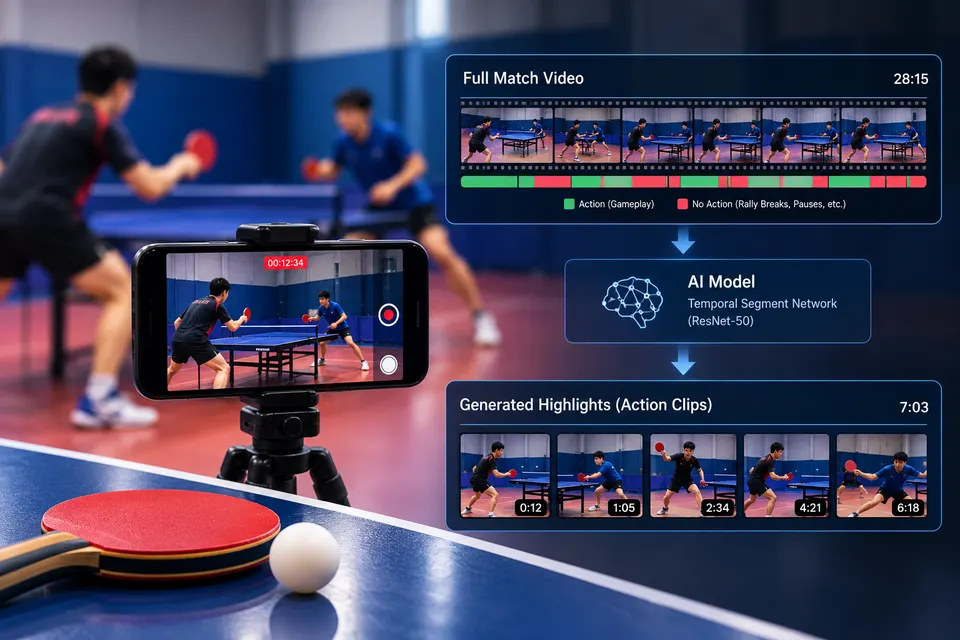
This study develops a machine learning system using a Temporal Segment Network with a ResNet-50 backbone to automatically identify active gameplay and generate highlights from amateur table tennis videos. The system achieved over 90% test accuracy while reducing viewing time by approximately 60 to 70%, demonstrating an efficient approach to automated sports video review.
The widespread use of smartphones has made it common for amateur players to record table tennis matches. However, active gameplay can account for less than half of the recording time (about 40% in our annotated match recordings), making manual review and highlight creation time-consuming. This study describes a machine learning system that automatically generates highlights from amateur table tennis videos by classifying video segments as Action or No Action. Using Temporal Segment Network (TSN) with a ResNet-50 backbone, the model classifies video clips using information from multiple sampled frames. The model does not explicitly perform ball or player tracking or pose detection. We converted a dataset of 28 manually annotated match videos containing over 253,000 labeled frames into over 5,800 fixed-length clips. We split the clips at the video level into training, validation, and test sets. The primary 64-frame model attained 88.7% validation accuracy and 92.28% test accuracy. A temporal sensitivity study showed that the 16-frame configuration achieved 90.10% validation accuracy with a Macro F1 score of 0.8997. The inference time also decreased from 16.55 ms/clip to 5.56 ms/clip compared with the 64-frame model. Another study comparing 10 different train-validation splits across the video set showed consistent performance among combinations. In practice, the generated highlights video reduced total viewing time by about 60–70%. This shows that a machine learning-based approach to automated highlight generation can make reviewing amateur table tennis matches significantly more efficient.
Explore More!



Related Projects




© 2022 Inspirit AI. All Rights Reserved.