Back To Projects

Integrating Pixhawk and Realsense Camera for Rover Autonomy

Nathan K.

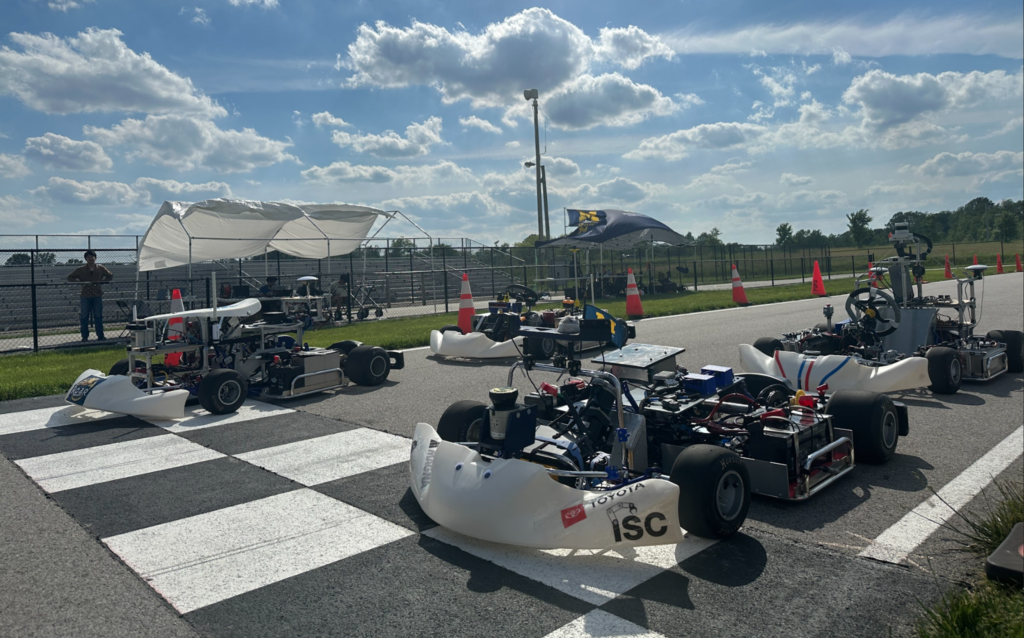
This study presents the design and implementation of a low-cost autonomous go-kart that uses a Pixhawk-4 flight controller and ArduPilot to enable waypoint-based navigation and speed control without human intervention. It also demonstrates how integrating an Intel RealSense depth camera improves safety through MAVLink-based obstacle avoidance, particularly in environments with obstacles.


This project demonstrates the design and implementation of an autonomous go-kart using a Pixhawk-4 flight controller for navigation and speed control. This system uses Pulse Width Modulation signals to control a brushless motor via an electronic speed controller, allowing waypoint navigation-based autopilot without the need for human intervention. A secondary configuration integrates an Intel RealSense depth camera with a companion laptop running a Python script for obstacle detection, enhancing safety through MAVLink (Micro Air Vehicle Link) [5], based avoidance commands. Key results demonstrate successful waypoint navigation with accuracy in open and unobstructed environments, whereas the RealSense addition reduces collision risk in paths with obstacles. This project utilizes aerospace-grade autonomy using ArduPilot with ground vehicle applications, emphasizing a relatively low-cost application of autonomous systems.

Explore More!

Nathan K.
Samuel Akinwande

Related Projects

Quantifying the True Trade Value of NBA Players: A Data Driven Approach

This study investigates the drivers of NBA player valuation by analyzing performance metrics, advanced statistics, and salaries from the 2022–2023 season, using regression models to assess how performance relates to trade value. The findings show that while team payroll strongly correlates with team performance, individual player salaries often diverge from statistical output, highlighting the influence of factors beyond on-court performance.
Ali Q.
Mentored by Rami Abi-Akl
Predicting the Performance of Code using Machine Learning

The goal of this research paper is to see the potential of machine learning to predict the performance of a given program.
Zachary R.
Mentored by Zachary Gittelman
Self-supervised DINOv2 versus Supervised CNNs for Insurance Claim Cost Predictions

This study investigates whether vehicle insurance claim amounts can be predicted directly from images of damaged cars by comparing CNN models, the self-supervised DINOv2 model, and GPT-5.5 as a vision language model. Results showed that DINOv2 performed best, achieving an R² of 0.12 compared with 0.07 for ResNet152V2 and 0.08 for ResNeXt50, while GPT-5.5 tended to overestimate repair costs, particularly for severe damage.
Rohan V.
Mentored by Ivan Felipe Rodriguez