Back To Projects

Fake news detection, methods and data processing

Soham P.

In this project we studied several models to discern fake news articles from real news articles to find the best method.


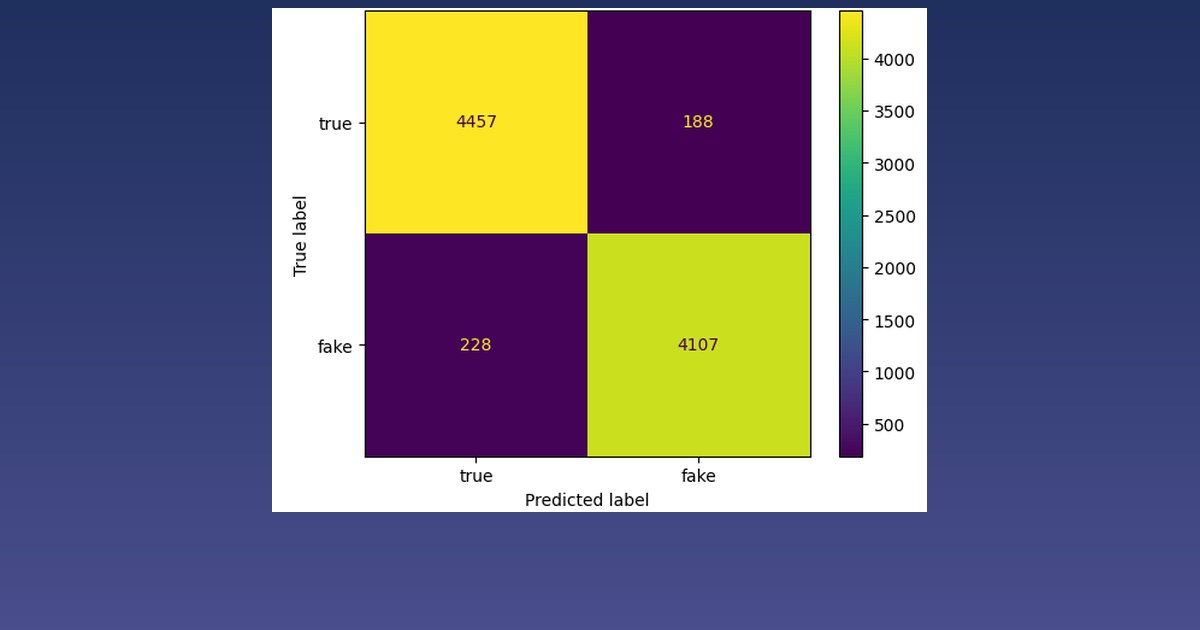
In this project we studied several models to discern fake news articles from real news articles to find the best method. Fake news has become very prevalent in the digital age. There are thousands of articles that were written with the intent to mislead in various subjects: politics, social issues, and conspiracies. Leveraging two datasets that have true news articles and fake news articles we used 4 different machine learning models and compared them to each other to find the best method. We looked at the accuracy, the features, and the percentage of false positives the models gave. We found that the best model out of the four that we used was the custom neural network which got an accuracy of 95.7%.

Explore More!

Soham P.
Erick Ruiz

Related Projects

Self-supervised DINOv2 versus Supervised CNNs for Insurance Claim Cost Predictions

This study investigates whether vehicle insurance claim amounts can be predicted directly from images of damaged cars by comparing CNN models, the self-supervised DINOv2 model, and GPT-5.5 as a vision language model. Results showed that DINOv2 performed best, achieving an R² of 0.12 compared with 0.07 for ResNet152V2 and 0.08 for ResNeXt50, while GPT-5.5 tended to overestimate repair costs, particularly for severe damage.
Rohan V.
Mentored by Ivan Felipe Rodriguez
Smart Agriculture: Optimizing Soil pH and Crop Recommendations Using Machine Learning

This study explores how hyperparameter tuning enhances the performance of machine learning models, achieving a 99.5% accuracy in crop classification and highlighting the potential of AI-driven optimization for sustainable precision agriculture.
Pracheth G.
Mentored by Henry Cerbone
A Late Fusion Approach with Multimodal Image-Text Data

This project explores late fusion methods in multimodal machine learning to improve emotion detection by combining image and text predictions, and evaluates their effectiveness compared to other fusion approaches using the MVSA-Single dataset.
Shreyes B.
Mentored by Varsha Sandadi