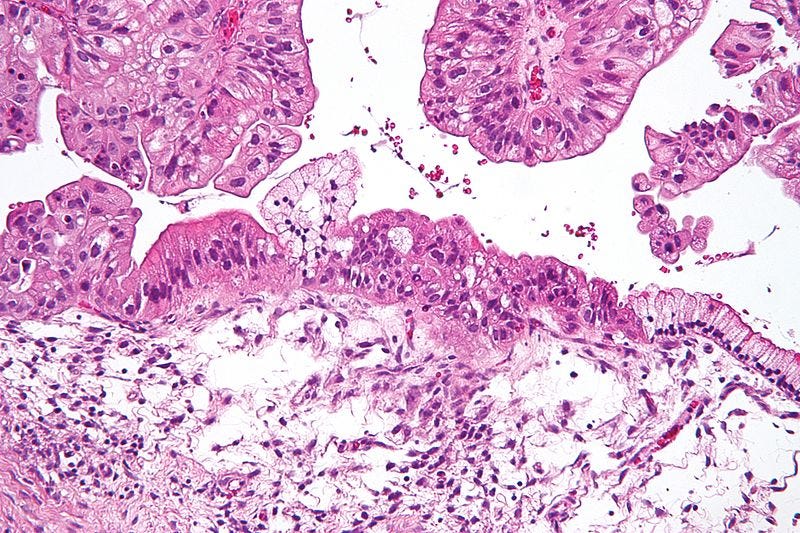
In this specific research project, we will be focusing on the lymph node scans of women with breast cancer, which is the most common cancer for women residing in the US, other than skin cancer. Research statistics show that about 1 in 8 women in the United States will develop invasive breast cancer throughout her life.
This paper discusses the development of a machine learning algorithm that accurately detects metastatic breast cancer (the cancer has spread elsewhere from its origin part) in select images that come from pathology scans of lymph node sections. Being able to develop an accurate artificial intelligence (AI) algorithm would help significantly in breast cancer diagnosis since manual examination of lymph node scans is both tedious and oftentimes highly subjective. The usage of AI in the diagnosis process provides a much more straightforward, reliable, and efficient method for medical professionals and would enable faster diagnosis and, therefore, more immediate treatment. The overall approach used was to train a convolution neural network (CNN) based on a set of pathology scan data and using the trained model to binarily classify if a new scan were benign or malignant, outputting a 0 or a 1, respectively. The final model’s prediction accuracy is very high, with 100% for the train set and over 70% for the test set. Being able to have such high accuracy using an AI model is monumental in regards to medical pathology and cancer detection. Having AI as a new tool capable of quick detection will significantly help medical professionals and patients suffering from cancer.
Explore More!
Related Projects


© 2022 Inspirit AI. All Rights Reserved.