Back To Projects

OCT Retinal Scan Classification Using Machine Learning

Amna H.

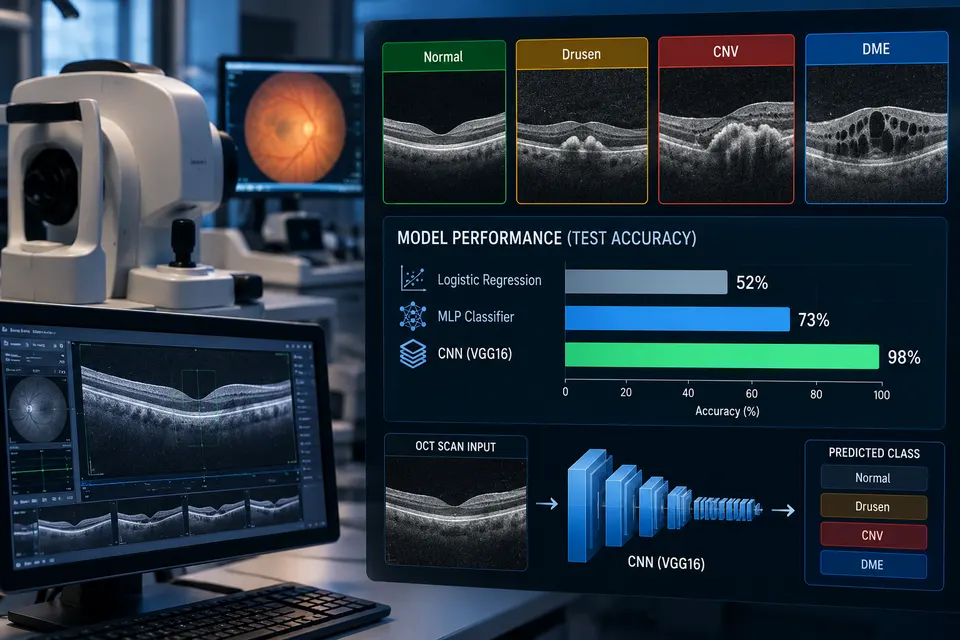
This study explores the use of machine learning to classify retinal OCT scans into four categories (Normal, Drusen, CNV, and DME) to support more accurate and consistent eye disease diagnosis. By comparing Logistic Regression, MLP, and CNN models, the study found that a CNN using the VGG16 architecture achieved the highest accuracy at 98%, demonstrating the potential of deep learning and transfer learning in retinal disease detection.


Optical Coherence Tomography (OCT) scans are non-invasive images that use light waves to take detailed pictures of the retina. These images can detect a variety of optical diseases that can affect the vision and function of the eye. Our project aims to compare different machine learning models in their ability to classify retinal images. We want to provide support to ophthalmologists by finding an algorithm that can produce consistent accurate diagnosis. In this project, we classified the OCT scans into four classes of diseases: Normal, Drusen, Chloroidal Neovascularization (CNV), and Diabetic-Related Macular Edema (DME). We used a Logistic Regression, MLP Classifier, convolutional neural network (CNN) with a VGG16 architecture, and compared each on their testing accuracy score. We found the Logistic Regression gave us an accuracy of 52%, the MLP Classifier gave us 73%, and the highest, CNN, with 98% accuracy. These results show that convolutional neural networks can efficiently classify OCT retinal scans accurately. The successful results from using a pre-trained architecture like VGG16 suggests that transfer learning is sufficient in separating the four classes in this dataset. However, before implementing in clinical settings, the model would require validation using scans from different patient populations and imaging devices.

Explore More!

Amna H.
Erick Siavichay
Computer Science Alum from Stanford, Software Engineering and Data Science at Tagg

Related Projects

Skin Cancer Detection

The goal of this research project is to predict whether or not a patient has skin cancer through a machine learning model that is developed from an image dataset. Skin cancer is extremely dangerous, as over 9500 people in the US are diagnosed with it daily. If detected early, patients will have a more likely chance of survival. I tested an MLP Classifier, Decision Tree Regressor, a Logistic Regression Model, and a KNN Model to compare various results and ultimately determine the best accuracy. The MLP Classifier had a 74.5% accuracy, the Decision Tree Regressor had a 74.1% accuracy, the Logistic Regression Model had a 68.8% accuracy, and the KNN Model had a 74.6% accuracy (all testing). We can see that the MLP Classifier, Decision Tree Regressor, and the KNN Model had around the same accuracy while outperforming the Logistic Regression Model. However, when comparing training data, there seems to be a large overfitting problem with most of the models.
Jaida G.
Mentored by Odysseas Drosis
Plant Toxicity Classification by Image

Since differentiating between dangerous and safe plants is a complex task for a human brain, this study approaches the issue through machine learning models starting with a convolutional neural network (CNN) and discovering that a logistic regression model—trained on a dataset with manually designed features—has the best performance with the particular dataset used.
Eera B.
Mentored by Clayton Greenberg
Using Machine Learning Models to Determine Medical Features Most Indicative of Gestational Diabetes

With the recent overruling of Roe v. Wade, pregnancies have become especially dangerous since many females who previously abort fetuses no longer can. By doing this research project, I can help figure out what medical factors may lead to gestational diabetes, and hopefully from there, the results can be used to counteract those features.
Fiona B.
Mentored by