
Predicting Precipitation and Other Weather Conditions With Logistic Regression and Random Forest Classifiers
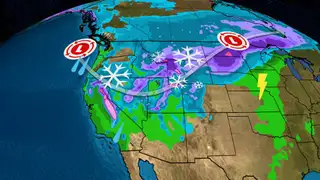
An issue we have with our current algorithms is the inability to predict weather accurately for any time range further than ten days. Our intentions with this project were to create a model that could get an accuracy within 5% of our current weather prediction algorithms.
Nowadays, we predict the weather to get a better understanding of the days to come. An issue we have with our current algorithms is the inability to predict weather accurately for any time range further than ten days. Our intentions with this project were to create a model that could get an accuracy within 5% of our current weather prediction algorithms. We wanted the model to be accurate in both short-term and long-term conditions. Our current algorithms, while highly accurate in the short term, struggle in the long-term timespan. The importance of accuracy in this model can be boiled down to two main points; convenience, for planning activities, and safety, as perhaps an early warning system in the event of a possibly harmful or fatal weather event. Our method of achieving these goals was to first use a logistic regression model, and later a random forest classifier. In the end we reached a highest accuracy of 83%, which fell just short of our goal of 85%. Despite the inaccuracy, our model showed promising results, and if we had more time or a larger dataset, the accuracy could have been higher. In the end, the results seemed more to be a proof of concept, rather than a demonstration of accuracy and capability.
Explore More!
Related Projects

© 2022 Inspirit AI. All Rights Reserved.