Back To Projects

Art Intel - Making AI your Ally in the Creative Process

Satvi M.

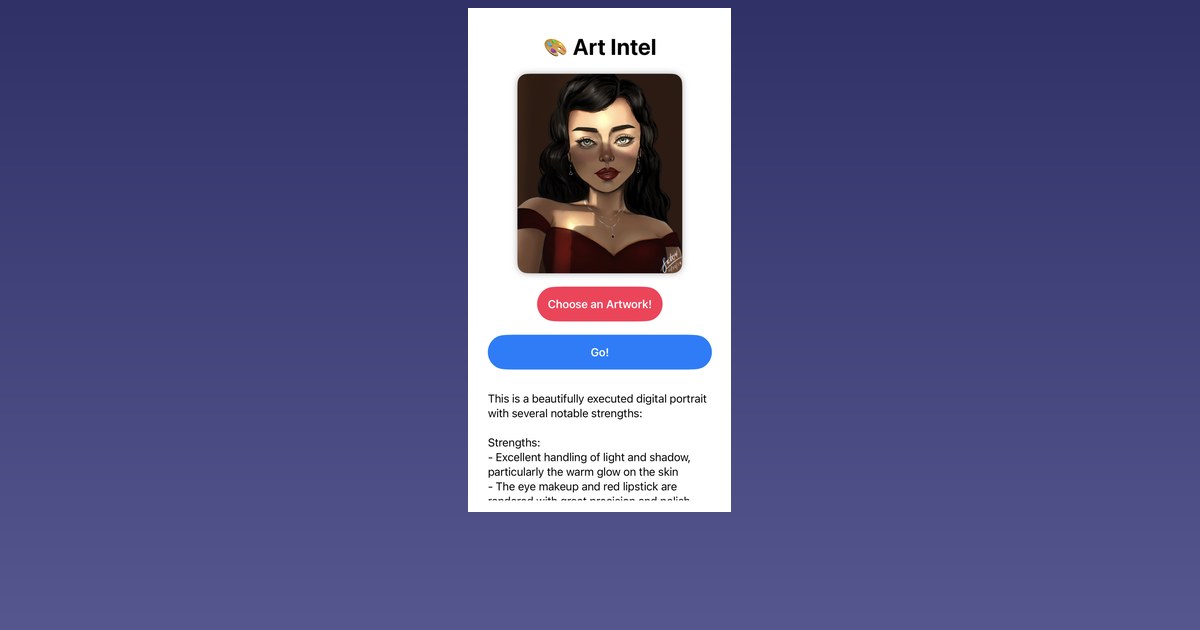
Art Intel is an app that uses generative AI to support and enhance the artistic process without replacing or undermining human creativity. Instead of producing finished pieces for users to claim, it guides artists in refining their work while preserving their creative control.


“Artificial Intelligence is demolishing our creativity.” These words have been uttered by nearly every artist today. People use AI to create art, but not in the ethical way that it should be used, that is, the art generated by the AI is taken and claimed as their original work. This is often the result of a lack of creativity, but it can also cause creativity to reduce as well. So, instead of using AI in a way that hinders the creative process, I wanted to use it in a way that promotes the process. My app Art Intel combines my passion for art and my interest in artificial intelligence by utilizing generative AI to serve as an ally in the creative process to solve that problem. Rather than the AI giving back an image with the fixes made, making it easy for the artist to steal it and claim it as their own, Art Intel will be by your side to guide you down the path from good art to great art, without taking away creative liberties.

Explore More!

Satvi M.
Rebecca Funke

Related Projects

From Text to Visuals: Leveraging AI for Immersive Storytelling

This research investigates the use of AI to generate visual representations of Edgar Allan Poe's literary works, aiming to enhance reader engagement by bridging traditional literature with modern digital media through AI-generated imagery, while identifying challenges related to visual consistency and narrative complexity.
Ian M.
Mentored by Alaisha Alexander
Classifying AI-Generated Music with AI Models

The importance of this research is twofold: addressing copyright issues and fostering the adoption of AI in the music industry. As AI-generated music blurs the line between human and AI creation, concerns regarding copyright ownership and artistic attribution become paramount [2]. To address these challenges, we created an AI model to differentiate AI-generated music from human-composed music, specifically focusing on music generated by the JukeBox model.
Siddharth M.
Mentored by Anthony Cuturrufo
Using Machine Learning Models to Predict Asthma Hospitalizations Based on Air Pollutants

This study uses a Decision Tree regression model to analyze the relationship between air pollution (PM2.5, NO2, O3) and asthma hospitalizations in New York City, revealing significant prediction challenges and highlighting the potential for targeted healthcare interventions based on regional health vulnerabilities.
Nikhil T.
Mentored by Kyra Kraft