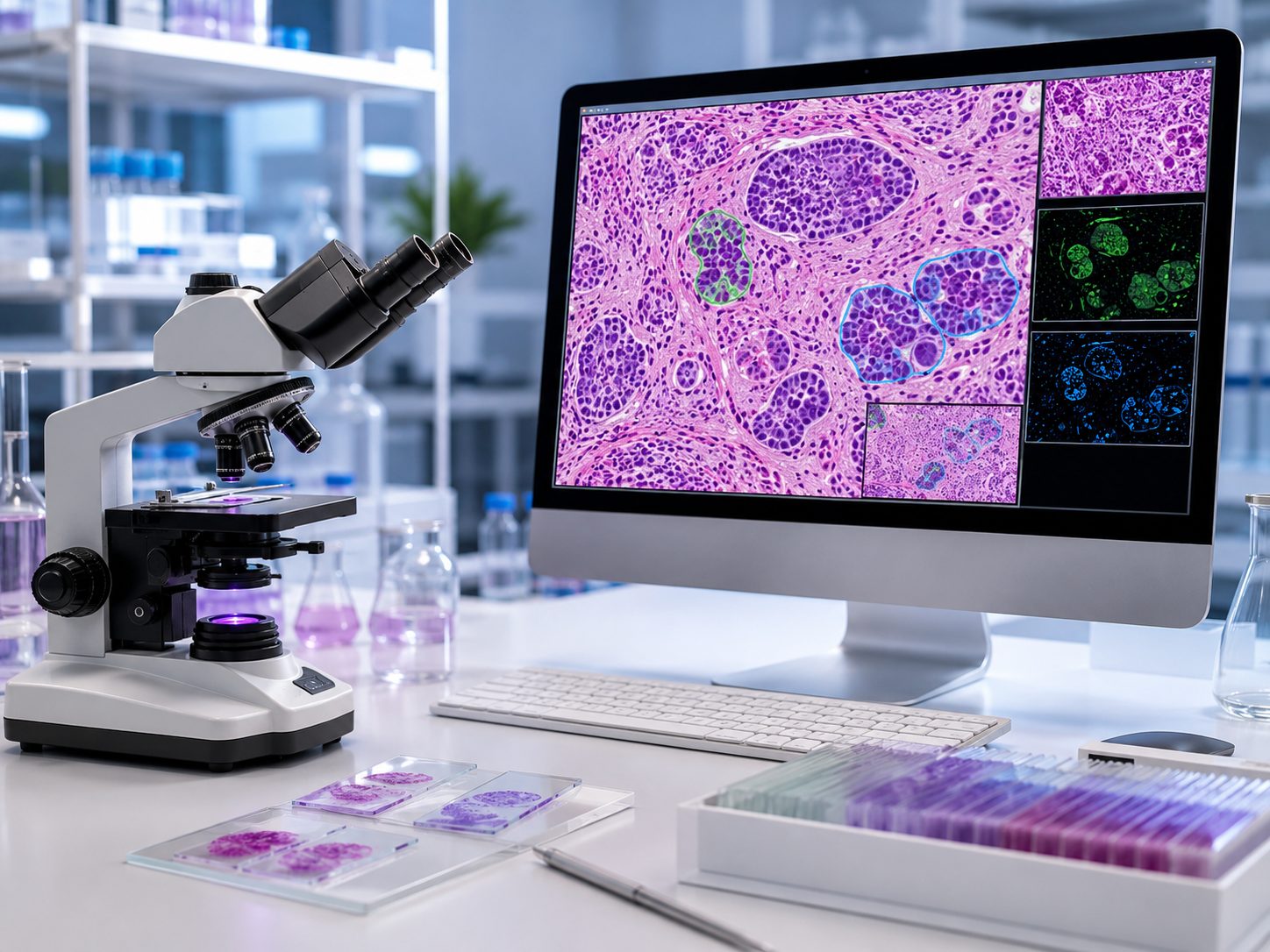
This study evaluated multiple deep learning approaches for automatically classifying breast cancer histopathology images as malignant or benign. The models demonstrated strong performance, with Keras Sequential achieving the highest accuracy (85.7%) and precision (88.4%), while VGG19 achieved the highest recall (94.8%), highlighting the potential of deep learning to support breast cancer diagnosis.
Breast cancer is one of the most common cancers worldwide, and early, accurate diagnosis is essential for improving patient outcomes. Histopathological image analysis from biopsy remains a key method for identifying malignant and benign breast tissue, but manual review can be time consuming which may delay treatment decisions when the cancer progresses rapidly. In this study, we evaluated several deep learning methods including the CNN and pre-trained models for automated classification of breast cancer between the malignant and benign samples from a curated dataset of histological images. Images were balanced before training, and model performance was evaluated using metrics including accuracy, precision, recall, and confusion matrix analysis. The results showed that the models were able to achieve strong classification performance, with the Keras Sequential having the highest accuracy (85.7%) and precision (88.4%), and the VGG19 the highest recall (94.8%). These findings support the potential of deep learning as a tool for assisting histopathological breast cancer diagnosis, and potential future work exploring ensemble approaches combining the best-performing models to further improve robustness and classification accuracy in challenging cases.
Explore More!
Related Projects


© 2022 Inspirit AI. All Rights Reserved.